
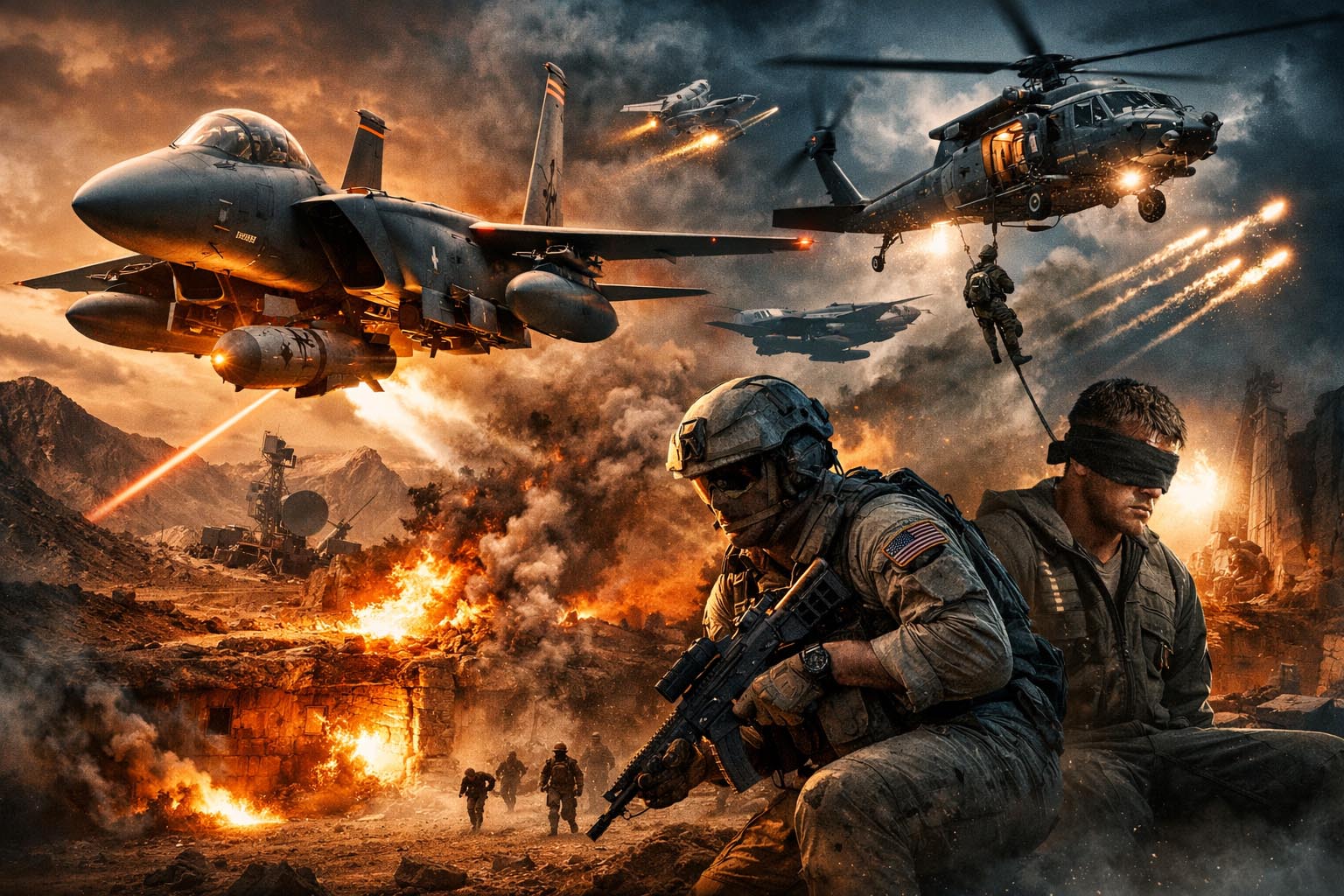
US Air Force Rescue Mission in Iran: Downed Jet, Missing Officer & Rising Tensions
What began as a precision strike mission quickly evolved into a geopolitical flashpoint—one that blends high-end warfare, intelligence ambiguity, and global tension.
This is a deeper, more detailed breakdown of every layer of the story.
1. The Deep Strike Mission: هدف (Objective)
At the center of this operation was a deep penetration strike, likely targeting fortified underground infrastructure.
Aircraft Involved
The primary platform: F-15E Strike Eagle
This aircraft is specifically designed for:
Long-range interdiction
Heavy payload delivery
Precision targeting in hostile zones
Weapon System
The strike likely involved the GBU-28
Why GBU-28 matters:
Can penetrate 5–6 meters of reinforced concrete
Designed for deep underground bunkers
Requires laser designation + stable trajectory
Deployment Complexity
Unlike standard bombing runs:
Aircraft must fly low and fast to avoid radar
Then climb briefly to achieve correct release angle
Maintain laser lock until impact
This is exactly why comparisons to Top Gun: Maverick are being made—because the margin for error is almost zero.
2. The Engagement: How the Jet Was Shot Down
Iran’s air defense network is layered and increasingly advanced.
Possible Threat Systems
While exact systems remain unconfirmed, analysts point to:
Long-range radar-guided SAM systems
Mobile missile batteries
Integrated radar + IR tracking
What Likely Happened
Jet entered contested airspace
Detected by ground radar or IR tracking
Missile lock achieved
Pilot deployed countermeasures (flares/chaff)
One missile still connected or proximity-detonated
Result: Aircraft disabled → forced ejection
3. The Crew Split: Seconds That Changed Everything
Inside the F-15E:
Pilot → Controls aircraft
Weapons Systems Officer (WSO) → Manages targeting, sensors, and weapons
After ejection:
They landed in different zones
Terrain + darkness created immediate separation
Why This Matters
Rescue becomes twice as complex
Communication depends on survival radios
Enemy forces may reach site faster than rescue teams
4. The Rescue Operation (CSAR): $400M War Gamble
This was a full Combat Search and Rescue (CSAR) operation—not a simple pickup.
Key Assets Deployed
Rescue Helicopters
Low-altitude penetration
Night-vision operations
Extraction under fire
Close Air Support
Provides heavy fire cover
Can suppress enemy ground units
Air Superiority & Stealth
Likely used for stealth overwatch
Electronic warfare + intel gathering
Additional Support
ISR drones (real-time surveillance)
Refueling tankers
Electronic jamming aircraft
Why It Cost ~$400M
Multi-aircraft deployment
High-risk enemy airspace
Advanced tech + personnel
Mission duration + coordination
This wasn’t just a rescue—it was a military-scale operation inside hostile territory
5. Iran’s Narrative: “Not Just a Rescue”
Iran responded strongly.
Key Claims
Operation = military incursion
Not humanitarian, but strategic penetration
Possible intent to:
Gather intelligence
Locate nuclear-related assets
Test air defense systems
Strategic Messaging
This framing serves multiple purposes:
Strengthens domestic narrative
Signals resistance to U.S. operations
Justifies future escalation if needed
6. The Missing WSO: The Most Critical Unknown
While one airman was rescued…
The Weapons Systems Officer remains missing.
Possible Scenarios
1. Evasion Mode
Using survival training
Avoiding detection
Waiting for extraction
2. Captured
By military or paramilitary units
Could become strategic leverage
3. Injured / KIA
No signal due to damage or condition
Why This Matters Globally
A captured U.S. airman inside Iran would:
Trigger international crisis protocols
Become a political bargaining tool
Escalate tensions dramatically
7. Strategic Implications: Bigger Than One Mission
This incident is not isolated.
It Signals:
Increased willingness for deep strike operations
Rising US–Iran military friction
Testing of defense and response capabilities
Possible Outcomes:
Diplomatic escalation
Proxy conflicts intensifying
Cyber + intelligence warfare increase
Authority Sources
To strengthen your blog’s credibility and ranking, link to high-authority sources like:
Military & Defense Analysis
Global News Coverage
Geopolitical Context
Final Line
This is no longer just a mission report.
It’s a story of precision, survival, and uncertainty—
where one successful rescue doesn’t mean the mission is over.
Because somewhere in hostile territory…
one man is still missing.
About the Author
Ahsan writes about technology, global news, and digital trends. His articles focus on simplifying complex topics and helping readers understand important global developments.
Comments (0)
No comments yet. Be the first to comment.
Related Posts
Middle East conflict escalation map
A deep analysis of the Iran–Israel war, exploring military escalation, global power involvement, oil market risks, and the possibility of a wider geopolitical conflict.

The Education Business
Over the past decade, a new industry has emerged at the intersection of technology and learning: EdTech (Education Technology).
Iran–Israel War 2026 Update: Missile Strikes, Iranian Navy Ship Sinking & Global Power Politics
Latest Iran–Israel war update (March 2026): Iranian missile strikes on Israel, the sinking of the Iranian warship IRIS Dena, and the geopolitical tensions involving the US, Israel, and India.