
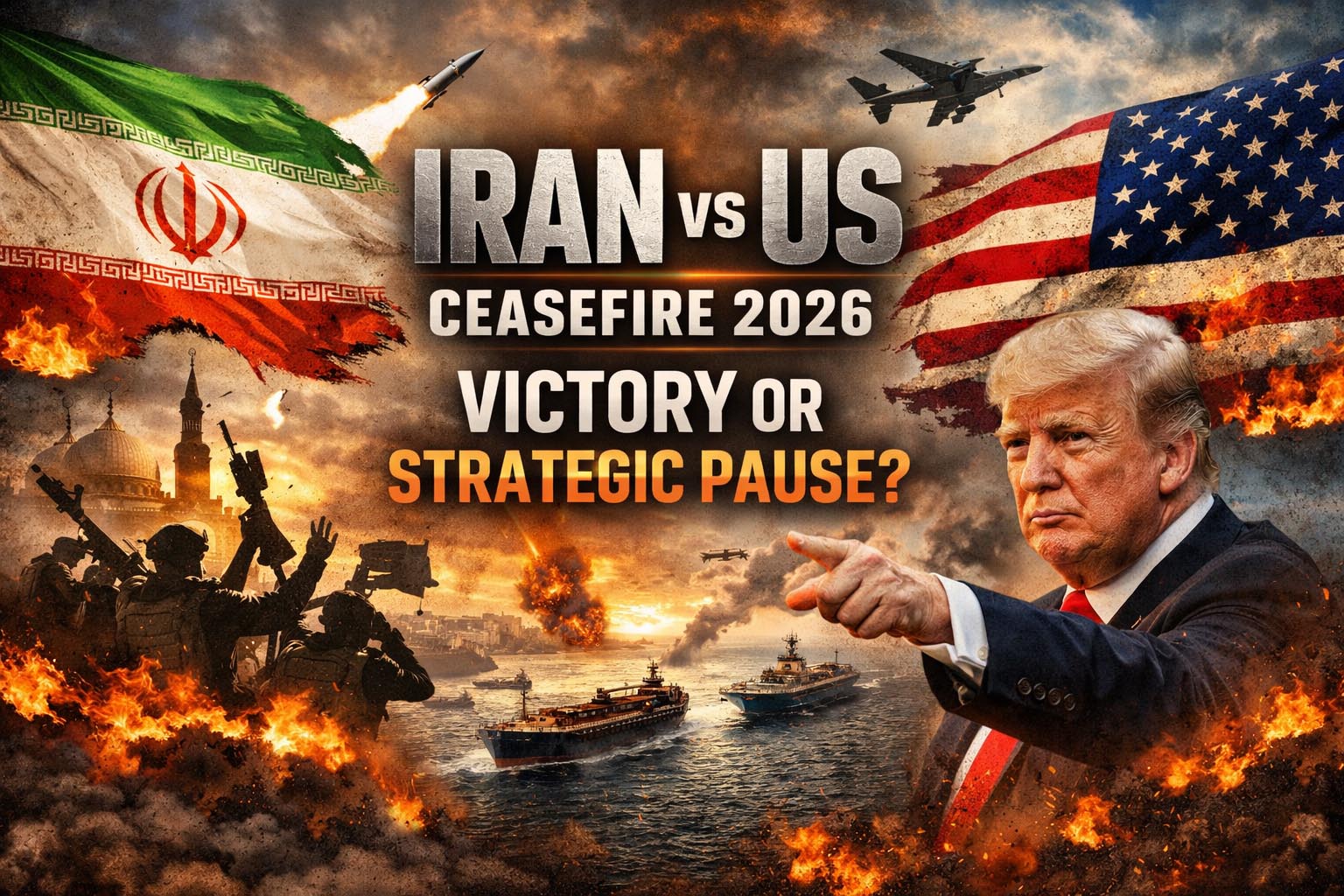
Iran–US Ceasefire 2026: Victory, Stalemate, or Strategic Pause?
The recent escalation between the United States and Iran brought the world dangerously close to a large-scale regional war. What began as targeted military operations quickly evolved into a high-stakes geopolitical confrontation involving energy routes, military deterrence, and global alliances.
However, just as tensions peaked, both sides agreed to a temporary ceasefire, opening the door to negotiations. This development has sparked a critical question across analysts, policymakers, and observers:
Did Iran win, or is this merely a strategic pause by the United States?
This article provides a comprehensive, evidence-based analysis supported by multiple international sources and reports.
The Immediate Context: From Escalation to Ceasefire
The crisis intensified following a series of U.S. airstrikes targeting key Iranian infrastructure, particularly energy facilities and strategic assets.
According to Reuters:
Trump says US won 'total and complete victory' after ceasefire deal with Iran, AFP reports | Reuters
The escalation triggered fears of disruption in the Strait of Hormuz, a vital global oil chokepoint responsible for transporting nearly 20% of the world’s oil supply.
More context on the crisis:
https://www.washingtonpost.com/world/2026/04/07/trump-us-iran-war-threat/
Additional developments:
https://www.wsj.com/livecoverage/iran-war-latest-news-updates-2026/
Key Ceasefire Outcome:
A 2-week temporary ceasefire agreement
Mediated by regional powers including Turkey, Pakistan, and Egypt
Conditional on maintaining global oil supply stability
Supporting coverage:
https://timesofindia.indiatimes.com/world/middle-east/usiran-agree-to-twoweek-ceasefire/
Iran’s 10-Point Proposal: Strategic Positioning
At the center of negotiations is Iran’s proposed 10-point framework, which outlines its conditions for long-term de-escalation.
Detailed breakdown:
Explainer: What is in Iran’s 10-point ceasefire plan and will the US agree to it?
Core Elements:
Full lifting of U.S. sanctions
Withdrawal of U.S. military forces from the Middle East
Access to frozen Iranian assets
Security guarantees for Iran and allied groups
Continued nuclear development rights
Recognition of regional influence
Analysis source:
https://www.abc.net.au/news/2026-04-08/donald-trump-cedes-ground-to-iran-before-negotiations-even-begin/
These demands are widely considered maximalist, meaning they are likely designed as a starting point for negotiation rather than final terms.
Trump’s Statement and U.S. Position
Former U.S. President Donald Trump framed the outcome as a decisive American success.
Full statement coverage:
Trump says US won 'total and complete victory' after ceasefire deal with Iran, AFP reports | Reuters
Additional reporting:
Live Updates: U.S., Iran reach 2-week ceasefire ahead of Trump's deadline
Key Takeaways:
Claimed a “total and complete victory”
Asserted U.S. military objectives were achieved
Described Iran’s proposal as a “workable basis” for negotiation
This reflects a dual strategy:
Public messaging of strength
Behind-the-scenes willingness to negotiate
Strategic Leverage: What Each Side Gained
To evaluate whether this situation represents a “win,” it is essential to analyze the strategic outcomes for both nations.
Iran’s Gains
Forced the United States into negotiations
Maintained leverage over global oil routes
Prevented further escalation and damage
Preserved key geopolitical demands
Supporting insight:
https://www.abc.net.au/news/2026-04-08/donald-trump-cedes-ground-to-iran-before-negotiations-even-begin/
U.S. Gains
Successfully conducted targeted military strikes
Secured stability in the Strait of Hormuz
Avoided long-term military entanglement
Maintained strategic pressure through negotiations
Additional reporting:
https://nypost.com/2026/04/07/world-news/us-strikes-irans-oil-critical-kharg-island/
Is This a Victory for Iran?
Argument in Favor
Some analysts argue Iran achieved a strategic advantage:
The U.S. paused escalation
Iran’s framework shaped negotiations
Power shifted from unilateral pressure to mutual dialogue
Is This a Strategic Pause for the U.S.?
Argument in Favor
Others believe the U.S. is regrouping:
Reassessing military and diplomatic strategy
Avoiding overextension
Preserving long-term leverage
Coverage:
Trump agrees to suspend attacks for ‘two weeks’ if Iran opens Strait of Hormuz - The Washington Post
The Reality: A Tactical Stalemate
The most accurate interpretation is:
This is not a clear victory for either side
Instead, it represents:
A Tactical Pause
Both sides are regrouping and recalibrating.
A Negotiation Phase
Military confrontation has transitioned into diplomacy.
A Balance of Power
Iran leveraged geography and resilience
The U.S. leveraged military and economic strength
Global Implications
Energy Markets
Any instability in the Strait of Hormuz affects global oil prices and supply chains.
More insights:
https://www.wsj.com/livecoverage/iran-war-latest-news-updates-2026/
Regional Stability
Middle Eastern countries remain on high alert.
International Diplomacy
Countries like Turkey, Egypt, and Pakistan are increasingly influential mediators.
Conclusion
The Iran–U.S. ceasefire of 2026 represents a strategic equilibrium rather than a decisive victory.
Iran demonstrated resilience and negotiation strength
The United States maintained pressure while avoiding escalation
Ultimately, this is a pause—not the end—of the conflict
The future depends on:
Whether negotiations lead to a lasting agreement
Or tensions escalate again after the ceasefire
References
Trump says US won 'total and complete victory' after ceasefire deal with Iran, AFP reports | Reuters
Explainer: What is in Iran’s 10-point ceasefire plan and will the US agree to it?
Trump agrees to suspend attacks for ‘two weeks’ if Iran opens Strait of Hormuz - The Washington Post
https://www.wsj.com/livecoverage/iran-war-latest-news-updates-2026/
https://timesofindia.indiatimes.com/world/middle-east/usiran-agree-to-twoweek-ceasefire/
https://nypost.com/2026/04/07/world-news/us-strikes-irans-oil-critical-kharg-island/
About the Author
Ahsan writes about technology, global news, and digital trends. His articles focus on simplifying complex topics and helping readers understand important global developments.
Comments (0)
No comments yet. Be the first to comment.
Related Posts
Middle East conflict escalation map
A deep analysis of the Iran–Israel war, exploring military escalation, global power involvement, oil market risks, and the possibility of a wider geopolitical conflict.

The Education Business
Over the past decade, a new industry has emerged at the intersection of technology and learning: EdTech (Education Technology).
Iran–Israel War 2026 Update: Missile Strikes, Iranian Navy Ship Sinking & Global Power Politics
Latest Iran–Israel war update (March 2026): Iranian missile strikes on Israel, the sinking of the Iranian warship IRIS Dena, and the geopolitical tensions involving the US, Israel, and India.