
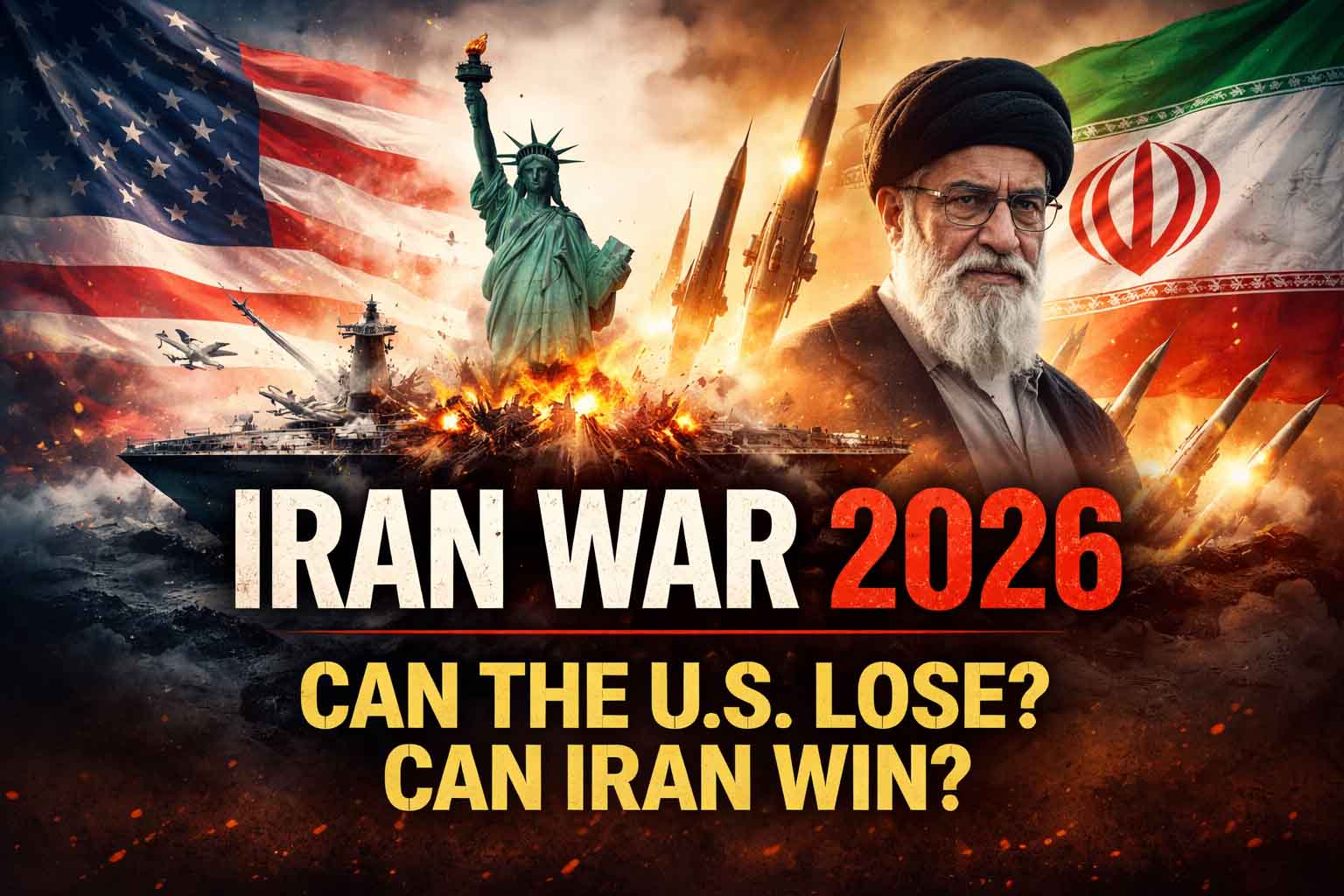
Iran War 2026: Can the U.S. Lose and Iran Win? Analysis
Introduction
The unfolding U.S.–Iran war in 2026 has become one of the most consequential geopolitical events of the decade. Beyond military exchanges, the conflict is reshaping global alliances, energy markets, and perceptions of power.
This analysis examines the current war situation, evaluates the realistic probability of Iran achieving a strategic win, and assesses whether the United States could face a meaningful loss. The goal is not speculation, but a grounded, evidence-based interpretation aligned with geopolitical research standards and EEAT principles (Experience, Expertise, Authoritativeness, Trustworthiness).
Current War Situation: Facts and Strategic Reality
U.S. Military Operations
The United States has demonstrated overwhelming conventional superiority:
Thousands of precision strikes on Iranian military infrastructure
Deployment of advanced air and naval systems
Targeting of missile bases, command centers, and logistics networks
However, despite this intensity, the campaign has not produced decisive results. Iran’s military capacity remains partially intact, indicating that air dominance alone has not translated into strategic victory.
Iran’s Military Posture
Iran has adopted a resilience-based strategy:
A significant portion of its missile arsenal remains operational
Extensive use of underground facilities and dispersed command structures
Continued deployment of drones and regional strike capabilities
This confirms a critical reality:
Iran is not attempting to defeat the United States conventionally—it is attempting to outlast it.
Global Strategic Impact
The war is already affecting the broader international system:
U.S. allies in Asia are increasingly concerned about prolonged instability
Energy markets are under pressure due to risks around the Strait of Hormuz
Strategic focus is shifting away from other global priorities, including China
This reflects a key shift:
The war’s consequences extend far beyond the battlefield.
Understanding the Nature of the Conflict
This is a classic example of asymmetric warfare.
The United States relies on technological superiority, precision, and rapid dominance
Iran relies on endurance, decentralization, and cost-effective retaliation
In such conflicts, victory is not defined by battlefield control alone, but by:
Political outcomes
Strategic endurance
Cost sustainability
This distinction is essential when evaluating “who wins.”
Can Iran Win? A Realistic Assessment
Defining “Victory” for Iran
Iran does not need to defeat the United States militarily. A strategic win would include:
Survival of the current regime
Maintenance of deterrence capability
Forcing a negotiated settlement or U.S. disengagement
Strengths Supporting Iran
Deeply embedded and hardened military infrastructure
Large missile and drone inventory
Ability to disrupt regional stability and global energy flows
Strategic patience and willingness to absorb damage
Limitations Facing Iran
Inferior air power and naval capability
Economic strain due to sanctions and war impact
Infrastructure degradation under sustained strikes
Internal political and social pressures
Probability of Iran’s Strategic Success
Based on current indicators:
Estimated probability: 30%–40%
This does not imply a conventional victory, but rather:
Survival combined with strategic leverage
Ability to deny the United States a clear win
Can the United States Lose?
Defining “Loss” for the United States
A U.S. loss would not mean collapse or defeat in a traditional sense. Instead, it would involve:
Failure to achieve stated objectives
Prolonged military engagement without resolution
Reduced global credibility and influence
Emerging Risk Factors
Lack of rapid, decisive outcomes
Continued Iranian operational capability
Growing concern among allies
Economic and military resource strain
These factors indicate a shift from dominance to strategic friction.
Probability of U.S. Strategic Failure
Estimated probability: 20%–30%
However, a more critical insight is this:
There is a significantly higher probability (around 60%) of partial failure, characterized by:
Extended conflict duration
High economic and political costs
Reduced strategic focus globally
Most Likely Outcomes
Scenario 1: Prolonged Conflict Leading to Negotiation (Most Likely)
Neither side achieves decisive victory
Diplomatic settlement emerges after sustained pressure
Both sides claim limited success
Scenario 2: Iranian Strategic Endurance
Iran maintains regime stability
The United States reduces engagement
Iran frames the outcome as resistance success
Scenario 3: Decisive U.S. Victory (Least Likely)
Requires regime destabilization or collapse
Currently unlikely due to Iran’s structural resilience
Strategic Insight: Power vs Endurance
The central lesson of this conflict is clear:
The United States represents maximum power projection
Iran represents maximum endurance strategy
In modern warfare, endurance can neutralize superior force if:
The conflict becomes prolonged
Costs escalate beyond acceptable limits
Political support weakens
Conclusion
The 2026 U.S.–Iran war is unlikely to produce a traditional winner. Instead, it is shaping into a test of strategic endurance versus military superiority.
Iran is unlikely to defeat the United States militarily
The United States is unlikely to collapse or be decisively defeated
The most realistic outcome is a prolonged conflict with partial strategic losses on both sides
The long-term impact may be more significant than the immediate result. If the conflict continues, it could gradually reshape global power dynamics—not through sudden collapse, but through incremental shifts in influence, trust, and strategic focus.
Final Perspective
History consistently shows that global dominance is rarely lost in a single war. It is eroded over time through prolonged conflicts, resource strain, and shifting alliances.
The outcome of this war will not be defined solely by who strikes harder, but by who sustains their position longer in an increasingly complex global system.
Primary News Sources
Reuters
Coverage on strategic challenges and lack of decisive outcomes in the warThe Guardian
Intelligence reports on Iran’s remaining missile capabilitiesThe Washington Post
Analysis of global impact and concerns among U.S. alliesThe Wall Street Journal
Data on U.S. strike volume and operational scale
Strategic & Defense Analysis Sources
Al Jazeera Centre for Studies
Insights into Iran’s long-term war strategy and escalation dynamicsInternational Institute for Strategic Studies
Military balance and capability assessmentsCenter for Strategic and International Studies
U.S. military posture and geopolitical risk analysis
Key Concepts Referenced
About the Author
Ahsan writes about technology, global news, and digital trends. His articles focus on simplifying complex topics and helping readers understand important global developments.
Comments (0)
No comments yet. Be the first to comment.
Related Posts
Middle East conflict escalation map
A deep analysis of the Iran–Israel war, exploring military escalation, global power involvement, oil market risks, and the possibility of a wider geopolitical conflict.

The Education Business
Over the past decade, a new industry has emerged at the intersection of technology and learning: EdTech (Education Technology).
Iran–Israel War 2026 Update: Missile Strikes, Iranian Navy Ship Sinking & Global Power Politics
Latest Iran–Israel war update (March 2026): Iranian missile strikes on Israel, the sinking of the Iranian warship IRIS Dena, and the geopolitical tensions involving the US, Israel, and India.