
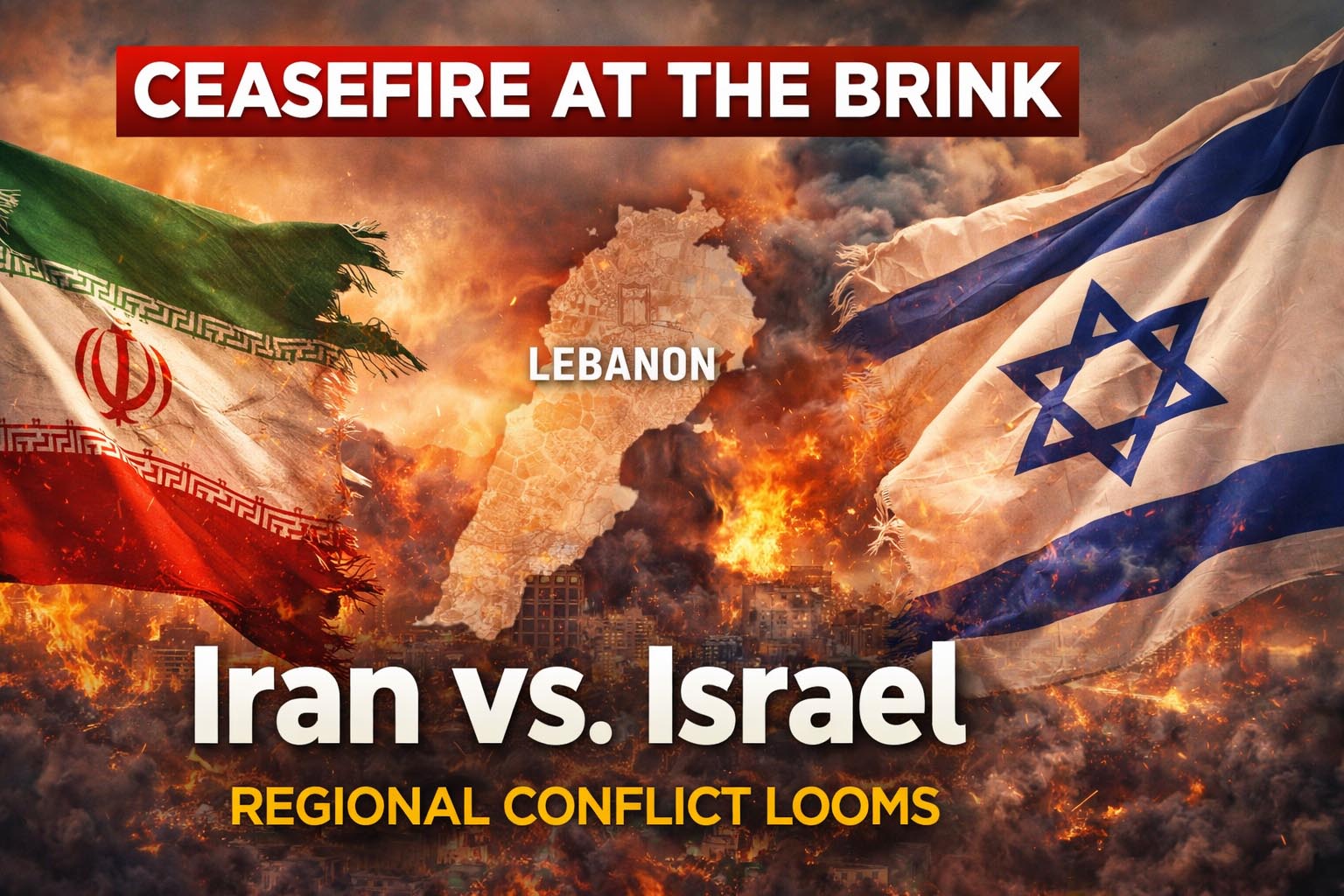
Iran vs Israel Ceasefire Crisis: Will War Break Out in Lebanon?
The warning did not arrive quietly. It arrived with the weight of consequence.
When Al Jazeera reported that Iran may withdraw from a ceasefire framework if Israel continues military actions in Lebanon, it was not merely a headline—it was an escalation in diplomatic language that historically precedes geopolitical rupture.
This is not an isolated development. It sits at the intersection of long-standing hostility, strategic deterrence, proxy warfare, and fragile diplomacy—documented consistently by institutions such as Reuters, BBC News, and The New York Times.
What is unfolding now is not just a regional crisis. It is a structural stress test of the international order.
The Framework Under Dispute: What Iran Claims Was Violated
At the center of the current tension is a 10-point negotiation framework, described by Iran as a “workable basis” for diplomacy. However, according to the official statement, multiple clauses have already been breached before meaningful negotiations even began.
Core Allegations
| Clause | Description | Alleged Violation | Strategic Implication |
|---|---|---|---|
| Ceasefire Scope | Immediate ceasefire including Lebanon | Continued Israeli operations in Lebanon | Undermines trust and baseline conditions |
| Sovereignty | Protection of Iranian airspace | Drone intrusion shot down in Fars Province | Signals direct security breach |
| Nuclear Rights | Recognition of Iran’s right to enrichment | Denial of enrichment rights | Reopens core dispute of nuclear negotiations |
These claims echo longstanding tensions surrounding Iran’s nuclear program, monitored by the International Atomic Energy Agency and debated within forums like the United Nations.
Iran’s conclusion is unequivocal: if the framework is violated at inception, the legitimacy of negotiations collapses.
Strategic Reality: There Is No Clear Winner
The question of victory is frequently raised, but analytically flawed.
Iran’s Position: Narrative Legitimacy
Iran is constructing a legal and diplomatic argument:
- Positioning itself as compliant and wronged
- Documenting violations to build international sympathy
- Reinforcing sovereignty and deterrence
Think tanks such as Council on Foreign Relations and Brookings Institution have long noted Iran’s reliance on asymmetric strategy combined with diplomatic framing.
Israel’s Position: Operational Dominance
- Preemptive and preventive strikes
- Neutralization of threats near its borders
- Maintaining regional deterrence credibility
Coverage by Associated Press and CNN indicates that Israeli strategy remains rooted in a security-first doctrine, even at diplomatic cost.
The Analytical Conclusion
There is no decisive winner.
- Competing strategic narratives
- Escalating risk calculations
- Increasing probability of miscalculation
Will the Ceasefire Hold? A Structural Assessment
Historically, ceasefires in the Middle East are not endpoints; they are temporary equilibrium states.
Research from the RAND Corporation highlights three determinants of ceasefire stability:
- Mutual trust (currently low)
- Enforcement mechanisms (unclear or absent)
- Alignment of strategic interests (divergent)
None of these conditions are currently satisfied.
Key Risk Factors
- Continued Israeli operations in Lebanon
- Iranian conditional participation
- Proxy escalation involving non-state actors
- External pressure from global powers
The model is brutally simple:
- Violation → escalation
- Escalation → collapse
Israel’s Strategic Options: A Decision Matrix
| Option | Description | Benefits | Risks |
|---|---|---|---|
| Sustained Military Pressure | Continue strikes in Lebanon | Maintains deterrence | Triggers Iranian withdrawal |
| Tactical De-escalation | Reduce visible operations | Preserves diplomacy | Perceived weakness |
| Escalation | Expand operational scope | Strategic dominance | Regional war |
Military analyses referenced by the Center for Strategic and International Studies suggest Israel is likely to pursue a hybrid approach—limited operations combined with controlled signaling.
However, hybrid strategies are inherently unstable in high-tension environments.
The Role of the United States: Between Influence and Constraint
The United States remains a central actor.
Iran’s accusation of repeated violations directly challenges U.S. credibility—highlighted by The Guardian and France 24.
Strategic Dilemma
- Enforce commitments → risk escalation
- Avoid confrontation → lose leverage
India’s Reaction: Economic Exposure and Political Complexity
For India, the crisis is not distant—it is directly connected.
Economic Dimension
- Dependence on Middle East oil
- Risk of rising fuel prices
- Inflationary pressure
Analysis from The Economist reinforces this vulnerability.
Political and Social Dimension
- Strategic alignment with Israel
- Historical ties with Iran
- Public opinion polarization
Information Warfare: Narrative vs Reality
Claims such as “Trump surrender” are not supported by verified institutional evidence.
They emerge from:
- Political amplification
- Viral misinformation
- Narrative warfare
Modern conflict is no longer confined to territory—it extends into perception.
Final Assessment: A System Under Strain
This is not yet war.
But it is no longer stable peace.
Most Likely Scenario
- Continued low-intensity conflict
- Fragile negotiations
- Ongoing instability
Worst Case Scenario
- Rapid escalation trigger
- Regional war
- Global economic disruption
The ceasefire still exists—on paper.
In reality, it survives only on restraint.
And restraint, in this environment, is the most fragile variable of all.
About the Author
Ahsan writes about technology, global news, and digital trends. His articles focus on simplifying complex topics and helping readers understand important global developments.
Comments (0)
No comments yet. Be the first to comment.
Related Posts
Middle East conflict escalation map
A deep analysis of the Iran–Israel war, exploring military escalation, global power involvement, oil market risks, and the possibility of a wider geopolitical conflict.

The Education Business
Over the past decade, a new industry has emerged at the intersection of technology and learning: EdTech (Education Technology).
Iran–Israel War 2026 Update: Missile Strikes, Iranian Navy Ship Sinking & Global Power Politics
Latest Iran–Israel war update (March 2026): Iranian missile strikes on Israel, the sinking of the Iranian warship IRIS Dena, and the geopolitical tensions involving the US, Israel, and India.