
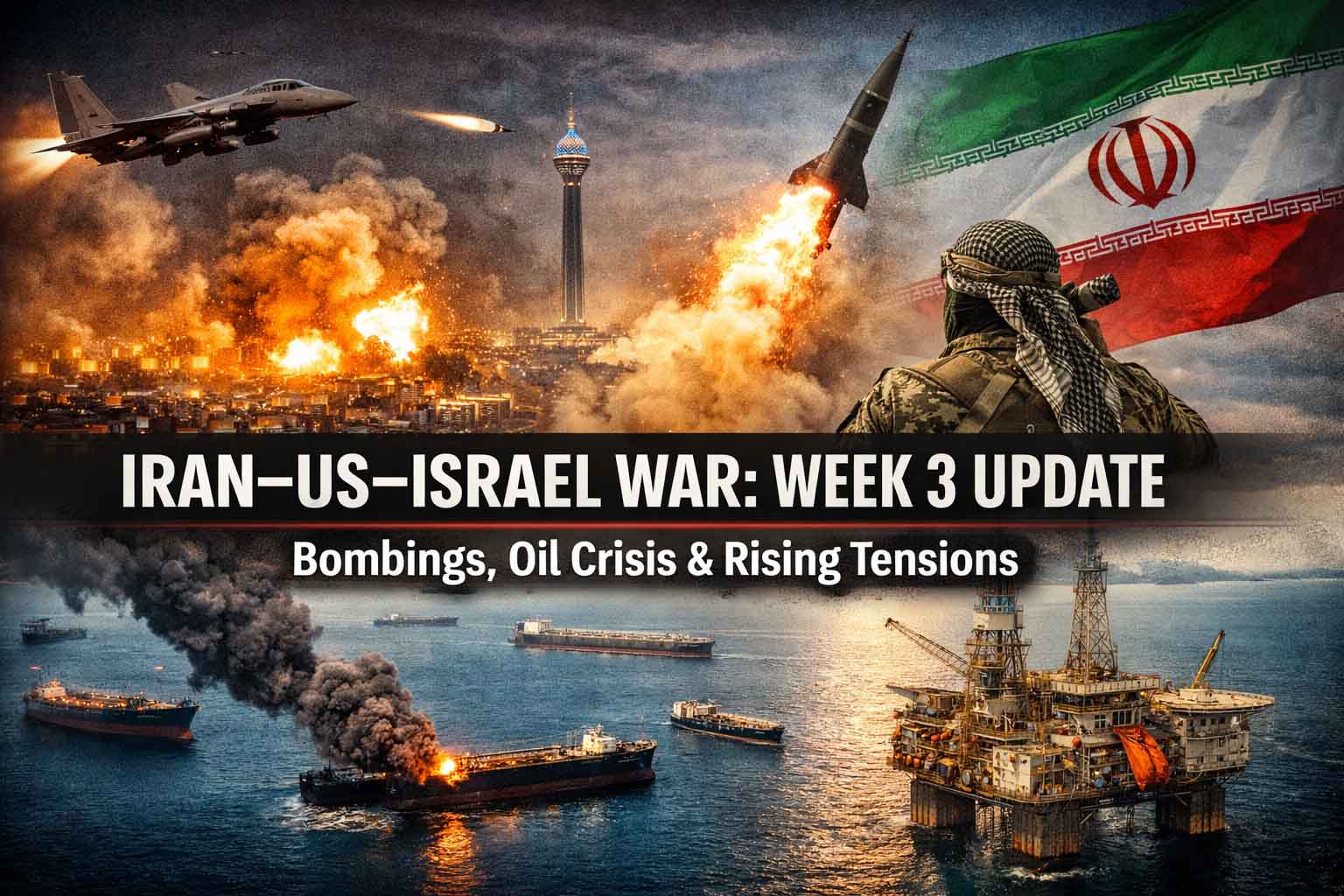
Iran-US-Israel war: week 3 update
Introduction
The ongoing conflict between Iran, the United States, and Israel has now entered its third week, transforming from a series of targeted strikes into a wider regional crisis affecting global oil markets, international shipping routes, and Middle East security.
Since the start of the war in late February 2026, thousands of missiles, drones, and airstrikes have been launched across the region. Military operations now extend from Iranian cities to the Persian Gulf and critical energy routes like the Strait of Hormuz.
This article provides a third-week war update, including military developments, economic impacts, casualty figures, and possible future scenarios.
Week 3 Iran War Update (March 2026)
1. Intensified Airstrikes Inside Iran
During the third week of the war, joint operations by the United States and Israel intensified with multiple strikes targeting Iranian military infrastructure.
Recent air raids hit several strategic locations including:
Heavy explosions were reported in Hamadan as part of ongoing bombing operations aimed at degrading Iran’s military capabilities.
Another major operation occurred at Kharg Island, one of Iran’s most important oil export hubs. The strike reportedly targeted more than 90 Iranian military sites located on the island.
Military analysts say the strategy is focused on:
Destroying ballistic missile launch systems
Targeting command and control infrastructure
Weakening Iran’s air defense networks
2. Iran’s Retaliatory Attacks Across the Region
Iran has responded aggressively with missile and drone attacks against Israeli targets and U.S. interests in the Gulf.
Key retaliation activities include:
Ballistic missile launches toward Israel
Drone strikes on Gulf infrastructure
Attacks near strategic oil hubs
Iran has also expanded its military operations beyond its borders, increasing tensions with Gulf states such as the United Arab Emirates.
In one incident, a fire broke out at the Fujairah oil hub following Iranian attacks linked to retaliation for U.S. strikes.
These attacks demonstrate that the war is no longer confined to Iran and Israel but has become a regional conflict affecting multiple Middle Eastern countries.
3. Strait of Hormuz Crisis and Global Oil Shock
One of the most critical developments in week three is the disruption of the Strait of Hormuz, the narrow waterway connecting the Persian Gulf with global energy markets.
The Strait normally transports over 20% of the world’s oil supply.
However, due to the war:
Tanker traffic has drastically reduced
Multiple ships have been attacked
Global oil markets are facing instability
Iran’s military warned that any vessel linked to the United States or Israel could be targeted in the waterway.
To stabilize energy markets, 32 countries coordinated the largest emergency oil reserve release in history, totaling around 400 million barrels.
This highlights how the conflict has become a global economic issue rather than just a regional war.
4. Rising Casualties and Humanitarian Concerns
The human cost of the war continues to rise.
According to official Iranian figures:
Over 1,255 people have been killed in Iran
More than 12,000 people have been injured
Casualties include civilians, healthcare workers, and children.
Meanwhile, missile strikes in Israel have also caused deaths and hundreds of injuries.
International leaders and organizations have begun urging a ceasefire.
Global religious leaders, including the Pope, have condemned the violence and called for diplomatic solutions.
Strategic Military Objectives
US–Israel Objectives
Military analysts believe the coalition’s goals include:
Destroying Iran’s missile production capability
Neutralizing nuclear-related infrastructure
Weakening Iran’s regional influence
Iran’s Objectives
Iran appears focused on:
Maintaining deterrence through missile attacks
Expanding the war to pressure Gulf allies
Disrupting global energy supply routes
Global Economic Impact
The conflict has already produced several economic consequences:
Oil Market Disruption
The war threatens the stability of global oil markets because the Persian Gulf supplies a large share of the world’s energy.
Aviation and Shipping Risks
Airlines and shipping companies have begun rerouting flights and vessels due to security risks across the Middle East.
Financial Market Reactions
Stock markets in Asia and Europe have seen volatility as investors react to rising geopolitical risk.
Possible Future Scenarios
Experts outline three potential outcomes for the conflict.
1. Prolonged Regional War
The war may continue for months, involving more Middle Eastern countries.
2. Diplomatic Ceasefire
International pressure could eventually lead to negotiations and a ceasefire agreement.
3. Major Escalation
The worst-case scenario could involve:
Closure of the Strait of Hormuz
Direct involvement of additional global powers
Severe global economic disruption
Conclusion
As the Iran–US–Israel war enters its third week, the conflict is evolving into a broader geopolitical crisis affecting the Middle East, global oil markets, and international security.
Key developments include:
Intensified airstrikes inside Iran
Iranian retaliation across the Gulf region
Disruption of the Strait of Hormuz
Rising civilian casualties and humanitarian concerns
With no ceasefire in sight, the coming weeks will determine whether the conflict stabilizes or escalates into a larger regional war with global consequences.
References
Al Jazeera – Iran War Updates (March 2026)
Reuters – International reactions and ceasefire calls
The Guardian – Strait of Hormuz shipping crisis
Foreign Policy – Global energy market analysis
About the Author
Ahsan writes about technology, global news, and digital trends. His articles focus on simplifying complex topics and helping readers understand important global developments.
Comments (0)
No comments yet. Be the first to comment.
Related Posts
Middle East conflict escalation map
A deep analysis of the Iran–Israel war, exploring military escalation, global power involvement, oil market risks, and the possibility of a wider geopolitical conflict.

The Education Business
Over the past decade, a new industry has emerged at the intersection of technology and learning: EdTech (Education Technology).
Iran–Israel War 2026 Update: Missile Strikes, Iranian Navy Ship Sinking & Global Power Politics
Latest Iran–Israel war update (March 2026): Iranian missile strikes on Israel, the sinking of the Iranian warship IRIS Dena, and the geopolitical tensions involving the US, Israel, and India.