
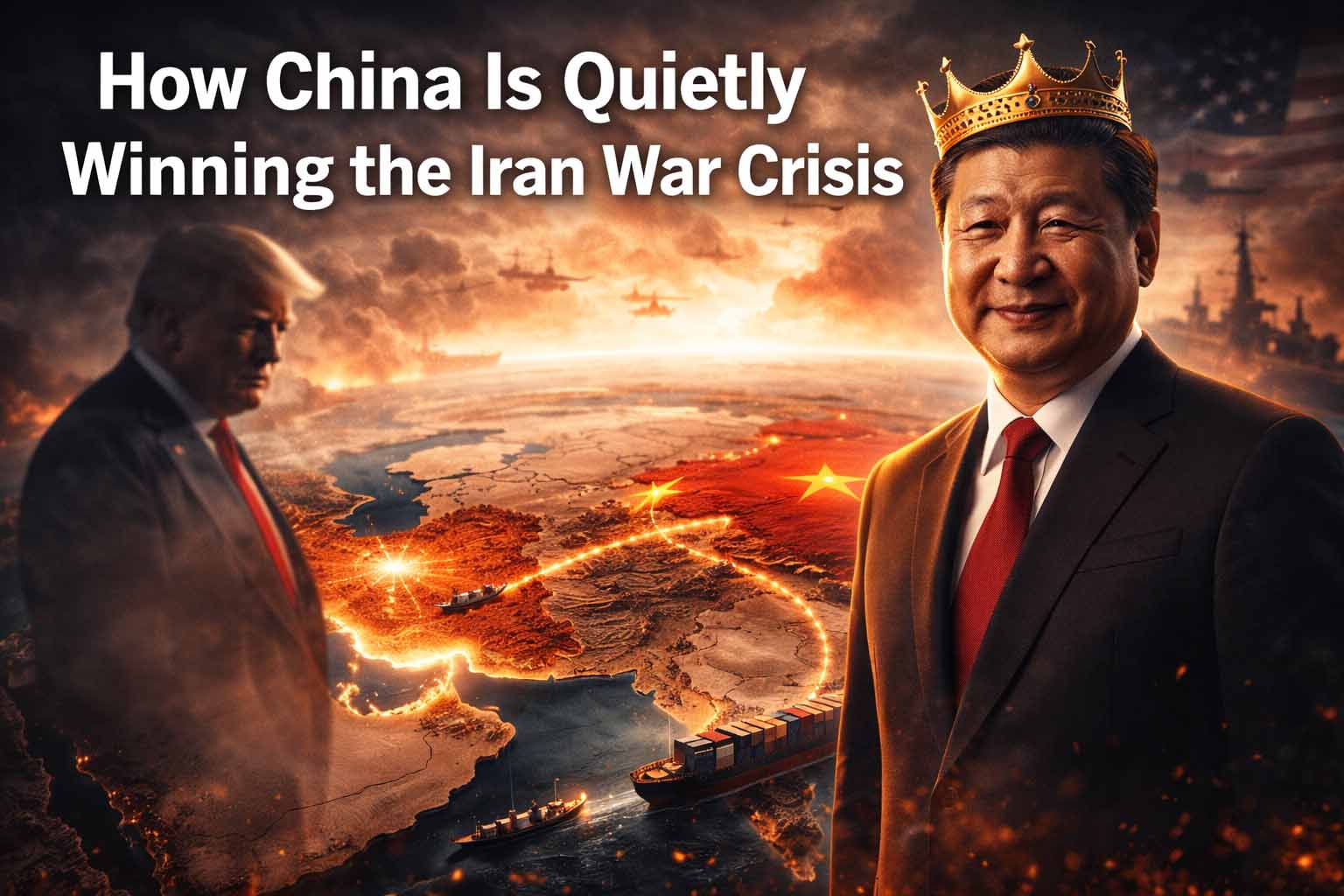
How China Is Quietly Winning the Iran War Crisis
A Deep Geopolitical Analysis (2026)
A War Beyond the Battlefield
The ongoing tensions surrounding Iran are not just a regional conflict—they are part of a broader geopolitical chessboard involving major powers like China and the United States.
While the U.S. remains visibly engaged in Middle Eastern affairs, China has adopted a quieter, more calculated approach—one that many analysts believe is yielding long-term strategic gains without direct military involvement.
This article explores how China is leveraging the crisis, what it stands to gain, and whether this signals a deeper global power shift.
China’s Strategic Position in the Iran Crisis
A Policy of Strategic Neutrality
China has positioned itself as a “neutral” actor in the Iran crisis. However, neutrality in geopolitics often masks strategic intent.
According to insights from Council on Foreign Relations, China’s approach in the Middle East prioritizes:
Stability for energy security
Avoidance of military entanglement
Expansion of economic influence
Balancing Relationships Across the Region
Unlike the U.S., China maintains relationships with:
Iran
Saudi Arabia
Israel
This multi-alignment allows China to:
Act as a diplomatic bridge
Avoid choosing sides
Maximize influence across rival blocs
Economic and Political Gains for China
Energy Security at Discounted Rates
One of China’s most tangible benefits is access to discounted Iranian oil, especially under Western sanctions.
Reports from Reuters indicate that:
China is Iran’s largest oil buyer
Sanctions have pushed Iran to sell oil at lower prices
This gives China:
Lower energy costs
Increased industrial competitiveness
Strategic energy reserves
Expansion of the Belt and Road Initiative (BRI)
China’s flagship global project, the Belt and Road Initiative, heavily involves the Middle East.
Iran plays a key role as:
A transit hub between Asia and Europe
A strategic node in logistics and trade routes
Long-term agreements between China and Iran include:
Infrastructure investment
Telecommunications
Transport corridors
“Winning Without Fighting”: China’s Strategic Doctrine
The Art of Indirect Power
China’s strategy aligns with principles often attributed to Sun Tzu:
“The supreme art of war is to subdue the enemy without fighting.”
China is:
Avoiding military costs
Letting rivals expend resources
Strengthening its economic foothold
Contrast with U.S. Military Engagement
The United States continues to:
Maintain military bases
Spend heavily on defense
Engage in regional conflicts
Meanwhile, China:
Invests instead of intervenes
Builds ports, roads, and trade routes
Gains influence without backlash
China’s Long-Term Objectives
1. Reducing Dependence on Western Systems
China aims to:
Bypass U.S.-controlled financial systems
Expand yuan-based trade
2. Securing Global Supply Chains
Control over:
Energy routes
Trade corridors
Strategic infrastructure
3. Expanding Political Influence
Through diplomacy and investment, China is:
Positioning itself as an alternative global leader
Offering a “non-interference” model appealing to many nations
Is the United States Handing Power to China?
A More Nuanced Reality
According to analysis from Brookings Institution and CSIS:
The U.S. is not simply “handing over” power, but:
Strategic overextension
War fatigue
Shifting domestic priorities
have created gaps that China is effectively filling.
Soft Power vs Hard Power Shift
U.S. → Military dominance (hard power)
China → Economic dominance (soft power)
The global system is transitioning toward a hybrid power model.
Current War Situation Analysis (2026)
Key Observations
Iran remains under heavy sanctions but economically resilient
Regional tensions continue through proxy conflicts
Global energy markets remain volatile
China’s role:
Quietly stabilizing supply chains
Avoiding direct confrontation
Expanding long-term agreements
Future Predictions: What Comes Next?
Short-Term (1–2 Years)
China increases oil imports from Iran
U.S. maintains military deterrence
No large-scale direct war
Mid-Term (3–5 Years)
China strengthens BRI infrastructure in the Middle East
Yuan-based trade increases
Regional alliances shift toward multipolarity
Long-Term (10+ Years)
China emerges as the dominant economic power in the region
U.S. influence becomes more selective
A multipolar world order replaces U.S.-led unipolarity
FAQ: China, Iran, and Global Power Shift
1. Why is China supporting Iran indirectly?
China benefits economically and strategically without facing military risks.
2. Is China an ally of Iran?
Not formally. Their relationship is pragmatic, based on mutual interests.
3. How does China benefit from U.S. involvement?
By allowing the U.S. to bear military and political costs while it expands economically.
4. Is the U.S. losing global dominance?
Not immediately, but its relative dominance is being challenged.
5. What is China’s biggest advantage in this crisis?
Its ability to operate without direct conflict while gaining influence.
References & Sources
Conclusion: A Silent Shift in Global Power
China’s approach to the Iran crisis reflects a broader transformation in global strategy. Rather than engaging in direct conflict, it is leveraging economics, diplomacy, and patience.
The result is a subtle but powerful shift—one where influence is no longer defined solely by military strength, but by the ability to shape outcomes without firing a single shot.
About the Author
Ahsan writes about technology, global news, and digital trends. His articles focus on simplifying complex topics and helping readers understand important global developments.
Comments (0)
No comments yet. Be the first to comment.
Related Posts
Middle East conflict escalation map
A deep analysis of the Iran–Israel war, exploring military escalation, global power involvement, oil market risks, and the possibility of a wider geopolitical conflict.

The Education Business
Over the past decade, a new industry has emerged at the intersection of technology and learning: EdTech (Education Technology).
Iran–Israel War 2026 Update: Missile Strikes, Iranian Navy Ship Sinking & Global Power Politics
Latest Iran–Israel war update (March 2026): Iranian missile strikes on Israel, the sinking of the Iranian warship IRIS Dena, and the geopolitical tensions involving the US, Israel, and India.