
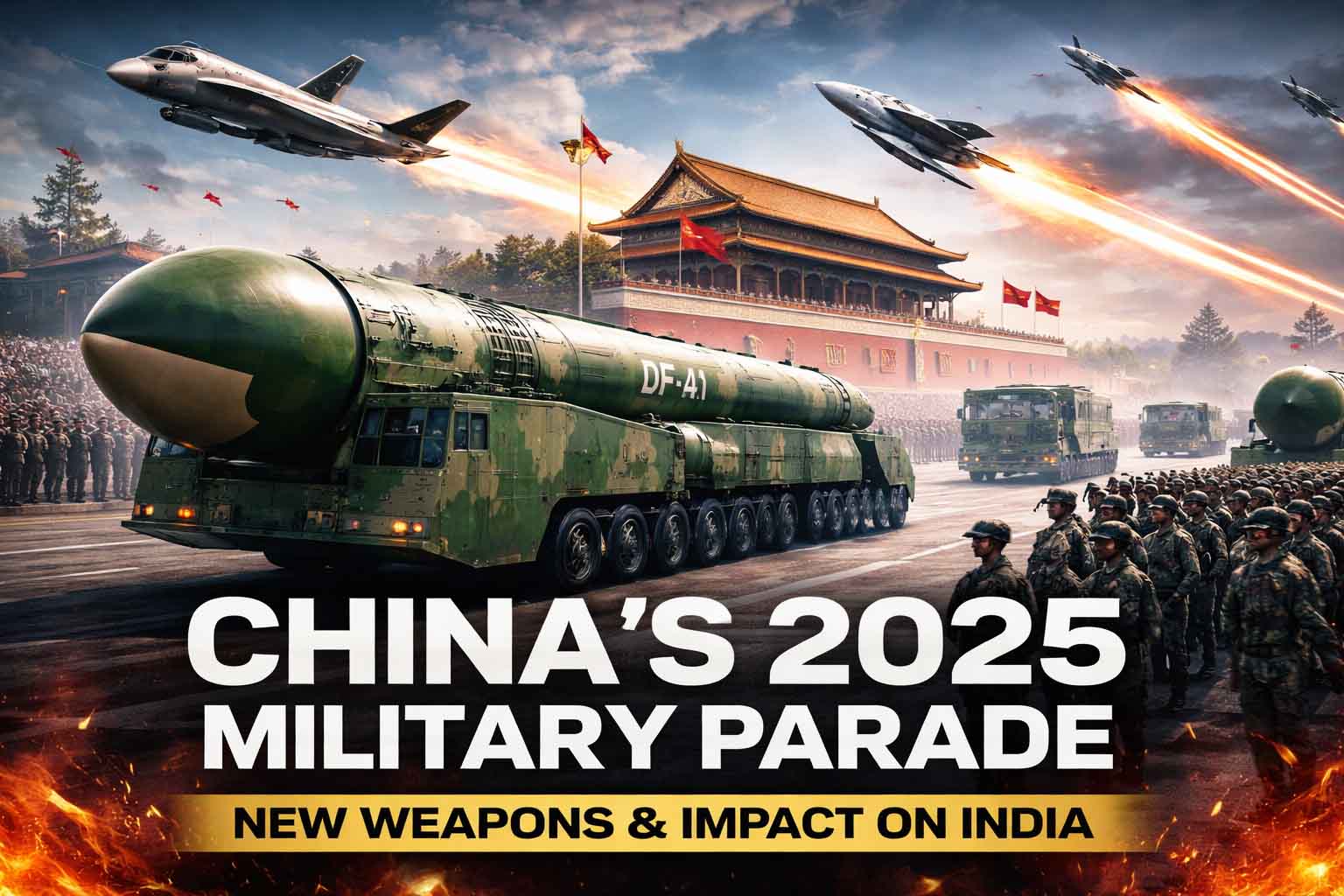
China Victory Day Parade 2025: New Weapons, Strategy, and Impact on India
China’s 2025 Victory Day military parade marked one of the most significant displays of military modernization in recent history. Far beyond ceremonial symbolism, the event showcased next-generation weapons systems spanning nuclear deterrence, hypersonic strike capabilities, artificial intelligence–driven warfare, and autonomous platforms.
This article provides a deep, research-backed analysis of three key aspects:
The new weapons China unveiled
The strategic message behind the parade
Why India should closely monitor these developments
All insights are supported by credible defense and global security sources.
New Weapons Unveiled by China
1. Expansion of the Nuclear Triad
China presented a fully operational nuclear triad—land, sea, and air-based nuclear delivery systems—placing it firmly among top-tier nuclear powers.
Key systems included:
DF-series intercontinental ballistic missiles (ICBMs) with multiple independently targetable reentry vehicles (MIRVs)
JL-3 submarine-launched ballistic missile (SLBM) for second-strike capability
Air-launched nuclear-capable missile platforms
This was the first time China publicly demonstrated all three nuclear delivery systems together.
Source:
Military.com – “China's Military Parade Reveals New Hypersonic Missiles, Drone Submarines and ICBMs”
China's Military Parade Reveals New Hypersonic Missiles, Drone Submarines and ICBMs
2. Hypersonic and Anti-Carrier Missile Systems
China displayed several hypersonic missile systems designed to target high-value naval assets, including aircraft carriers.
Notable features:
Speeds exceeding Mach 5
High maneuverability, making interception extremely difficult
Anti-access/area denial (A2/AD) capability aimed at limiting foreign military presence
These systems are particularly relevant in the Indo-Pacific theater.
Source:
Military.com
China's Military Parade Reveals New Hypersonic Missiles, Drone Submarines and ICBMs
3. Advanced Drone and Autonomous Warfare Systems
China highlighted its growing emphasis on unmanned systems, including:
AI-powered combat drones
Swarm drone technologies
Autonomous underwater vehicles (AUVs)
Ship-launched unmanned helicopters
These systems signal a shift toward network-centric and AI-driven warfare.
Source:
Reuters – “What weapons China put on display at its military parade”
What weapons China put on display at its military parade | Reuters
4. Directed Energy and Anti-Drone Weapons
The parade included emerging technologies such as:
High-energy laser systems
Microwave weapons capable of disabling electronics
Multi-layer anti-drone defense solutions
These technologies reflect lessons from modern conflicts, including the growing role of drones in warfare.
Source:
Reuters
What weapons China put on display at its military parade | Reuters
5. Next-Generation Air and Naval Platforms
China also showcased advancements in conventional military power:
Carrier-based stealth fighter jets
Upgraded naval strike systems
Modern air defense platforms
These enhancements support China’s broader maritime and regional dominance strategy.
Source:
Business Insider – “China's parade shows off lasers, intelligent tanks and missiles”
China's Military Shows Off Lasers, 'Intelligent Tank,' Missiles - Business Insider
6. AI-Integrated Ground Warfare Systems
Ground forces are increasingly incorporating intelligent systems, including:
Automated tanks
Robotic combat units
AI-assisted battlefield coordination
This represents a move toward integrated, multi-domain warfare.
Source:
Business Insider
China's Military Shows Off Lasers, 'Intelligent Tank,' Missiles - Business Insider
Strategic Message to Global Rivals
1. Assertion of Superpower Military Status
By demonstrating a complete nuclear triad and advanced hypersonic capabilities, China signaled that it is now operating at the same strategic level as major global military powers.
The message is clear: China is no longer a regional power but a global military competitor.
2. Deterrence Against Foreign Intervention
Anti-carrier missiles and long-range strike systems are designed to deter external military involvement, particularly in sensitive regions like the Taiwan Strait.
This aligns with China’s broader anti-access/area denial doctrine.
3. Focus on Future Warfare
The heavy emphasis on AI, autonomous systems, and electronic warfare indicates that China is preparing for next-generation conflicts rather than conventional wars.
This includes:
Cyber warfare
Space-based systems
AI-driven decision-making
4. Technological Self-Reliance
The majority of showcased systems were domestically developed, underscoring China’s goal of reducing reliance on foreign military technology.
5. Multi-Domain Operational Capability
China demonstrated integrated capabilities across:
Land
Sea
Air
Space
Cyber domains
This reflects a comprehensive approach to modern warfare.
Why India Should Be Concerned
1. Full Territorial Coverage by Advanced Missiles
China’s missile systems can reach all parts of India, significantly reducing response time and challenging existing missile defense systems.
2. Increasing Risk of a Two-Front Scenario
China’s military advancements could indirectly strengthen Pakistan’s strategic position, raising concerns about a potential two-front conflict.
3. Tactical Advantage in Border Regions
The deployment of drones, AI surveillance systems, and autonomous units enhances China’s operational efficiency in high-altitude border areas such as Ladakh.
4. Growing Naval Presence in the Indian Ocean
China’s expanding naval capabilities, combined with anti-ship missile systems and underwater drones, pose challenges to India’s maritime security and trade routes.
5. Technological Gap
China’s rapid progress in hypersonics, AI, and autonomous warfare highlights a widening technological gap that India must address through accelerated defense modernization.
6. Strategic Signaling and Psychological Impact
Military parades serve as tools of psychological influence. This display reinforces China’s intent to project strength and deter regional competitors, including India.
Conclusion
China’s 2025 Victory Day military parade was not merely a display of military hardware—it was a carefully calibrated strategic communication to the world.
The unveiling of advanced nuclear, hypersonic, and AI-driven systems underscores China’s transition into a future-ready military power. While the primary strategic competition remains with the United States, the implications for regional actors like India are significant.
India must respond with a balanced approach that includes technological advancement, strategic partnerships, and enhanced defense preparedness to maintain regional stability.
About the Author
Ahsan writes about technology, global news, and digital trends. His articles focus on simplifying complex topics and helping readers understand important global developments.
Comments (0)
No comments yet. Be the first to comment.
Related Posts
Middle East conflict escalation map
A deep analysis of the Iran–Israel war, exploring military escalation, global power involvement, oil market risks, and the possibility of a wider geopolitical conflict.

The Education Business
Over the past decade, a new industry has emerged at the intersection of technology and learning: EdTech (Education Technology).
Iran–Israel War 2026 Update: Missile Strikes, Iranian Navy Ship Sinking & Global Power Politics
Latest Iran–Israel war update (March 2026): Iranian missile strikes on Israel, the sinking of the Iranian warship IRIS Dena, and the geopolitical tensions involving the US, Israel, and India.