
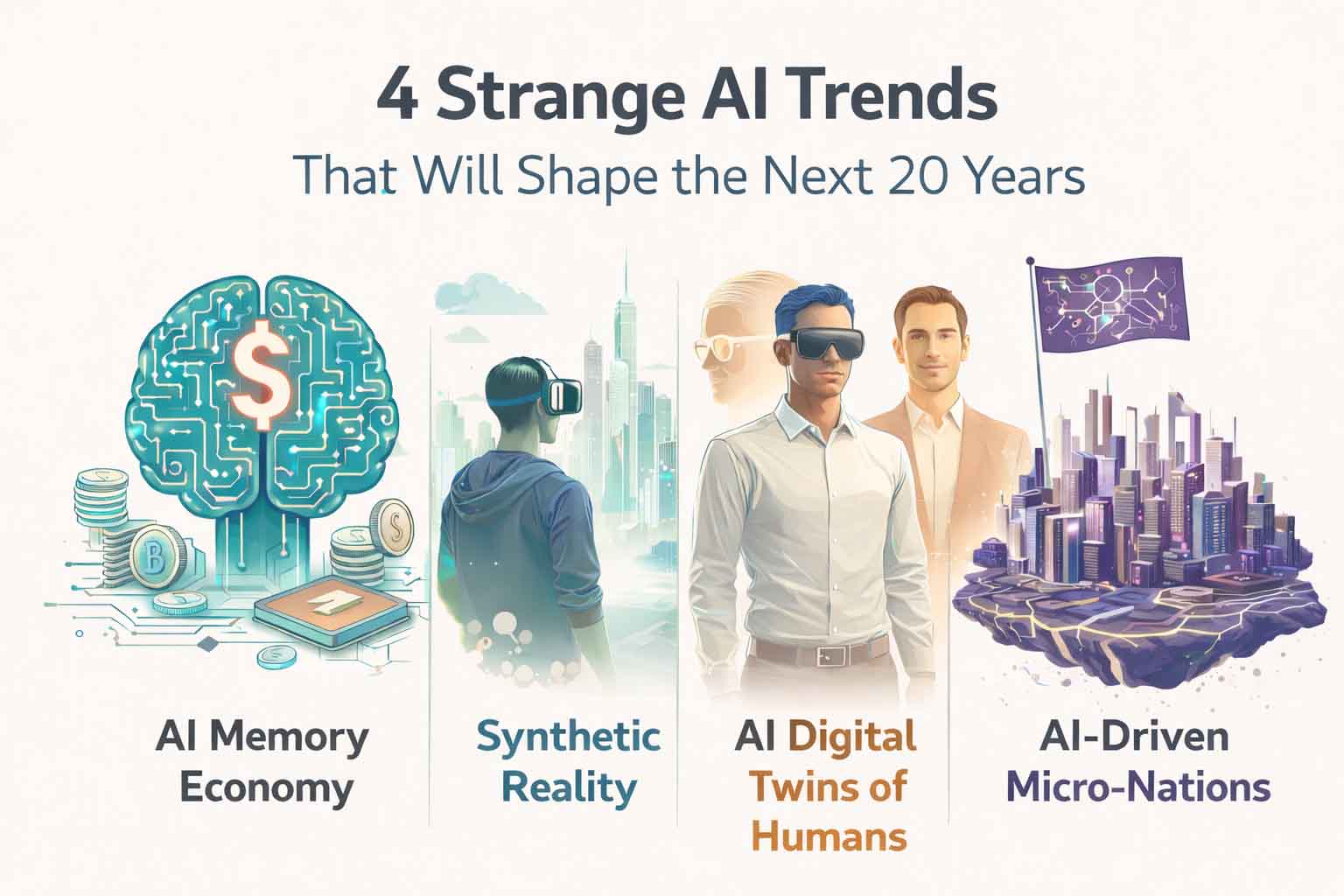
4 Strange AI Trends Nobody’s Talking About
AI is evolving in unexpected ways. Beyond obvious topics like job automation, four “hidden” AI trends could redefine our world: the AI memory economy, fully synthetic realities, human digital twins, and AI-managed micro-nations. This outline covers each trend in depth, with recent research and examples, plus blog angles and SEO suggestions.
AI Memory Economy
AI systems are moving beyond “stateless” chatbots to retain persistent memories about users. In this future, our personal experiences – from daily routines to travel logs – become valuable data commodities. Experts call this the AI memory economy, where your digital thoughts and history are owned, traded, or monetized. As one analysis notes, this lets you carry your digital identity between AI services, making personal data a “memory currency”[1].
How it works: New tools use vector databases and blockchains to securely store and update user memories[2][3]. For example, DeepMind’s Genie 3 uses persistent memory to keep AI assistants aware of past interactions. Startups like Supermemory (backed by Google execs) build “universal memory APIs” so apps can share user context[4][5].
Marketplace of memories: The idea of selling or licensing memory data is gaining traction. Cloudflare, for instance, is creating a marketplace where publishers set prices for AI training data scraped from their sites[6]. By analogy, individuals might someday trade their life logs or specialized knowledge with AI companies. Cryptographic solutions even promise user-owned memory vaults, so only you decide who sees your “digital thoughts”[1][3].
Business impact: Companies will compete to collect, protect, and monetize this data. Some visionaries predict entire data economies: e.g. Liberland (a crypto micronation) already sold “passports” and ran blockchain elections with its economy in Bitcoin[7][8]. We could see similar schemes for memory markets.
Ethical/legal issues: This raises tough questions. Who owns your memories? Consent and privacy become critical. Stanford’s HAI warns that our information (photos, resumes, chats) is often used in AI without consent, threatening privacy and even civil rights[9]. Policies like GDPR/CCPA and new laws (e.g. California’s AI Content Identification) will evolve. Digital rights management for personal data will be a legal battleground.
Key takeaway: In the AI memory economy, personal data is the currency. Users will need tools to manage what AI “remembers” or forgets[10][1]. The big shift won’t just be smarter AI, but who controls your digital memory[1][10].
Blog angles: “Will you sell your memories to AI?”, building a personal data marketplace, blockchain ‘memory wallets’, privacy and consent in the age of persistent AI.
Synthetic Reality & AI-Generated Worlds
AI is also creating entire digital realities on demand. Future work, education, and entertainment may take place inside AI-built environments rather than ordinary apps or websites. Cutting-edge research shows AI can turn a simple text prompt into a fully navigable 3D world. For example, Meta’s WorldGen system converts text descriptions into interactive, traversable environments with physics and navigation meshes[11][12]. In a few seconds you could have a city street or fantasy landscape that avatars can walk through.
World models: Google DeepMind’s “Genie 3” is a recent breakthrough: it generates realistic 3D scenes in real time (24 fps) from prompts, though current versions drift after a few minutes[13][14]. Similarly, Stanford built a simulated town (“Smallville”) populated by 25 AI agents with personal backstories; these agents went about daily routines and even coordinated events (one ran for “mayor”) without explicit programming[15]. These examples hint at virtual societies run by AI.
Applications: The implications are vast. Remote work: Imagine an AI-generated office or city for distributed teams, where managers and coworkers are avatars in a designed space. VR meeting platforms (like Meta’s Horizon) could use generative AI to build custom meeting rooms or campuses. Education: Teachers could launch interactive history lessons where students “visit” AI-recreated ancient civilizations. Entertainment and gaming: Procedural worlds (as seen in games like No Man’s Sky) will become common, but AI will make them more dynamic and personalized. Indie game devs can prototype entire levels from text prompts, then refine with human editors[16][11].
Platforms: Tools like Unity and Unreal Engine are integrating AI frameworks. Startups are emerging: for example, EmbodiedGen generates 3D assets for robotics tasks, and LatticeWorld creates large interactive worlds by blending LLMs with game engines. Nvidia’s Omniverse and Microsoft’s Mesh may incorporate such AI models.
Challenges: Current AI worlds have limits – short coherence, GPU demands, and safety concerns. WorldGen notes you still need humans to verify AI environments for realism and ethics[17][18]. A.I.-created worlds could simulate dangerous or deceptive scenarios (requiring governance)[18]. Ensuring virtual cities are safe and useful remains a research problem.
Key takeaway: Soon, everyday apps may give way to immersive, AI-built “spaces.” The future user might say, “ChatGPT, load the Paris office environment for our meeting,” and the AI will materialize a virtual Parisian cafe with your team’s avatars. This shift is already underway: Meta’s WorldGen (a research system) shows that “creating entire metaverse spaces … becomes as simple as entering a text prompt”[11][12].
Blog angles: AI-generated cities for remote workers, personalized dream-like VR spaces, education in AI-crafted worlds, the metaverse beyond VR headsets.
AI Digital Twins of Humans
Another emerging trend is AI digital twins: virtual clones of real people. These clones use an individual’s voice recordings, writings, photos, and behavioral data to mimic that person’s speech and decision-making. For example, London startup Synthesia lets users create talking-head avatars by recording a few minutes of video; the avatar can then speak any text in the user’s likeness[19]. Soon, full-body clones will exist.
What they are: In UX research terms, a digital twin is “a generative model … that attempts to act as a proxy for a particular person”[20]. Think of it as your AI double. It can answer questions, send messages, or make decisions as if it were you. The Nielsen Norman Group calls this an “artificial cognitive clone” built from your personal info[20]. Companies like HereAfter AI and StoryFile already build “digital immortality” products: you answer interview questions in your voice, and after you’re gone, loved ones can interact with the AI version of you[21][22].
Use cases: A trained AI twin could attend meetings or answer emails on your behalf. Zoom’s founder predicted that in ~5 years, people will routinely “send a digital twin to join” meetings so they can skip them[23]. Freelancers could have clones working 24/7: “AI assistants” that study your style and handle tasks while you sleep. Content creators use avatars to generate videos without re-recording themselves. Even customer service bots might speak in the voice of the brand’s founders. Another idea: matchmaking apps might use AI-selves to date for you, as imagined by the founder of Bumble[24].
Digital immortality: The “digital twin” can extend beyond career. Products like HereAfter AI let you archive family memories: you speak into an app today, and future generations can chat with your avatar years from now[21]. Museums use StoryFile’s hologram booths for historical figures (a WWII veteran, for instance) to answer visitors’ questions with his recorded responses[22]. This suggests a legacy where people “live on” as AI personas.
Ethical concerns: These innovations raise big issues. Cloning people (alive or dead) blurs identity and consent. The NNGroup notes serious questions: Who consents to creating your AI twin? Could your clone be misused or biased?[25]. StoryFile stresses it captures real interviews (not synthetic “ghosts”) to preserve authenticity. Laws are emerging: California now has digital likeness rights (AB 2602) to protect one’s image and voice after death[26]. We must ask if interacting with AI versions might distort grief or fuel misinformation (e.g. a “dead” person’s AI saying things they never would).
Key takeaway: AI twins could become commonplace “digital heirs.” If you grant consent, your avatar might manage your online presence, answer fan mail, or even “age” with you as your style changes. As one science writer observed, some people find the idea “uncanny, weird and creepy,” but others are eager: one child asked his cloned parent, “When can I have my own AI?”[27][28]. This trend forces us to reconsider identity, legacy, and what it means to be human.
Blog angles: “Your AI twin at work while you sleep,” making yourself digital-immortal, ethical line between clone and creepy, who controls your AI persona.
AI-Driven Micro-Nations
Finally, AI and blockchain could enable new digital-first nations. Imagine communities that exist almost entirely online, with their own currency, laws, and even AI bureaucrats. These micro-nations start as tight-knit crypto-communities and might crowdfund real territory later. They use smart contracts and DAOs (decentralized autonomous organizations) to vote on rules, possibly with AI moderators. Balaji Srinivasan calls them “network states”[29]: internet-born societies that could gain diplomatic recognition over time.
Existing experiments: Crypto micronations already hint at this. For example, Liberland (on the Croatia-Serbia border) issues Bitcoinstamps, held a blockchain voting election for its president, and plans to run 99% on Bitcoin reserves[7][8]. Satoshi Island (a planned project in Vanuatu) aims to be trustless and crypto-based, though it’s more theoretical[7]. These projects show how digital communities can create borderless governance and crypto-economies. As one report notes, they “challenge traditional sovereignty through decentralized governance and crypto-driven economies”[7].
AI involvement: In the future, AI could handle many functions of government. Smart contracts can already automate voting and budgeting. We may see proposals for AI “ministers” or even algorithmic constitutions. For example, Guam locals jokingly petitioned to have an AI-run government for impartiality. While real examples are scant, thought leaders discuss the idea of AI presidents and city “AI mayors” (e.g. China experimenting with algorithmic policy enforcement).
Advantages and risks: Advocates argue AI governance could be more efficient and bias-free. AI advisors could analyze data to suggest optimal laws, or digital juries could resolve disputes. But critics warn of huge risks: accountability (who’s responsible for an AI decision?), loss of human judgment, and power concentration in whoever controls the AI. Moreover, new digital states face real obstacles: international law doesn’t recognize them, and existing nations may resist any true sovereignty. Liberland’s experience shows that even with crypto and online communities, physical land and recognition are hard to secure[30].
Key takeaway: Borderless, technology-driven communities are already rising. The “internet century” might give birth to thousands of mini-states organized online[29]. Some will integrate AI into governance – perhaps a community where laws update via DAO votes or an AI-assisted census. Whether any become full-fledged countries or remain experiments, they illustrate how AI and blockchain could redefine governance. As one writer summarized Srinivasan’s view: “the internet is giving rise to internet places… the cloud is taking land”[31].
reference:[1] [2] Verifiable AI Memory — When AI Remembers, Who Controls the Truth?
https://blog.icme.io/verifiable-ai-memory-when-ai-remembers-who-controls-the-truth/
[3] Blockchain May Provide a Persistent Memory Layer for AI | Binance News on Binance Square
https://www.binance.com/en/square/post/01-20-2026-ai-35336852243793
[4] A 19-year-old nabs backing from Google execs for his AI memory startup, Supermemory | TechCrunch
[5] [13] [14] [15] AI Simulations: Virtual Worlds Where AI Agents Live & Learn | 2025 | Articles | o-mega
https://o-mega.ai/articles/simulations-how-ai-is-creating-the-worlds-where-ai-agents-live-2025
[6] Cloudflare wants to help you to get paid for the use of your data in AI training | CIO
[7] [8] [30] The Emergence of Crypto-Driven Micronations: A New Frontier in Decentralized Governance and Investment
[9] Privacy in an AI Era: How Do We Protect Our Personal Information? | Stanford HAI
https://hai.stanford.edu/news/privacy-ai-era-how-do-we-protect-our-personal-information
[10] AI Memory Economy: Your Data's New Gold Rush Revealed
https://aivibedaily.com/p/the-ai-memory-economy-why-your-data-just-became-the-hottest-commodity
[11] [12] [16] [17] [18] WorldGen: Meta’s AI Turning 3D Worlds Interactive
[19] [23] [24] [27] [28] Want your own AI double? Digital clones could bring big benefits — and risks
https://www.snexplores.org/article/ai-double-digital-clone-benefits-risks
[20] [25] Digital Twins: Simulating Humans with Generative AI - NN/G
https://www.nngroup.com/articles/digital-twins/
[21] [22] [26] Digital Clones: AI Avatars After Death | OnOff.gr
https://www.onoff.gr/blog/en/future/digital-clones-ai-avatar-after-death/
[29] [31] The Network State: Balaji Srinivasan’s Blueprint for Digital Sovereignty – JT Consulting & Media
https://joetechnologist.com/the-network-state-balaji-srinivasans-blueprint-for-digital-sovereignty/
FAQ
What is the AI Memory Economy?
The AI Memory Economy refers to a future system where personal data, experiences, and behavioral patterns become valuable digital assets used to train AI systems. In this model, individuals might store, control, or even sell their personal data to companies developing advanced AI technologies such as Artificial General Intelligence.
What are AI Digital Twins and how will they be used?
An AI Digital Twin is a virtual version of a person created using their voice, behavior patterns, and data. These AI clones could attend meetings, answer emails, or perform tasks on behalf of the real person. This concept is connected to the field of Digital Twin and may change how people work and interact online.
Could AI really create its own digital nations?
Some technologists believe AI and blockchain could enable digital-first countries where governance, economy, and social systems are managed online. This idea is linked to the “network state” concept popularized by Balaji Srinivasan, where communities form online and later build real-world infrastructure.
About the Author
Ahsan writes about technology, global news, and digital trends. His articles focus on simplifying complex topics and helping readers understand important global developments.
Comments (0)
No comments yet. Be the first to comment.
Related Posts

Middle East conflict escalation map
A deep analysis of the Iran–Israel war, exploring military escalation, global power involvement, oil market risks, and the possibility of a wider geopolitical conflict.
The Education Business
Over the past decade, a new industry has emerged at the intersection of technology and learning: EdTech (Education Technology).

Iran–Israel War 2026 Update: Missile Strikes, Iranian Navy Ship Sinking & Global Power Politics
Latest Iran–Israel war update (March 2026): Iranian missile strikes on Israel, the sinking of the Iranian warship IRIS Dena, and the geopolitical tensions involving the US, Israel, and India.